The FORSEEable: June 2026

Welcome to the FORSEE Newsletter, your gateway to updates on research results and perspectives in societally successful AI. Don’t be a stranger: check out our website, follow us on LinkedIn and Bluesky, and subscribe to this newsletter! The path to AI success runs through regulation Drawing on FORSEE’s research across multiple stakeholder groups, including policymakers, industry actors, civil society, media, and … Read more
The FORSEEable: May 2026

Welcome to the FORSEE Newsletter, your gateway to updates on research results and perspectives in societally successful AI. In this newsletter: Don’t be a stranger: check out our website, follow us on LinkedIn and Bluesky, and subscribe to this newsletter! What does “AI success” actually mean and for whom? Across Europe, policymakers are working towards building a successful AI ecosystem, from … Read more

The FORSEEable: November 2025

Welcome to follow FORSEE! FORSEE is a Horizon Europe research project that defines what successful AI means for society. Instead of focusing only on technological and economic success, we explore how AI can serve diverse social needs, even when expectations conflict. Our eight-partner consortium works to enhance the capabilities of the European AI industry, policymakers, … Read more

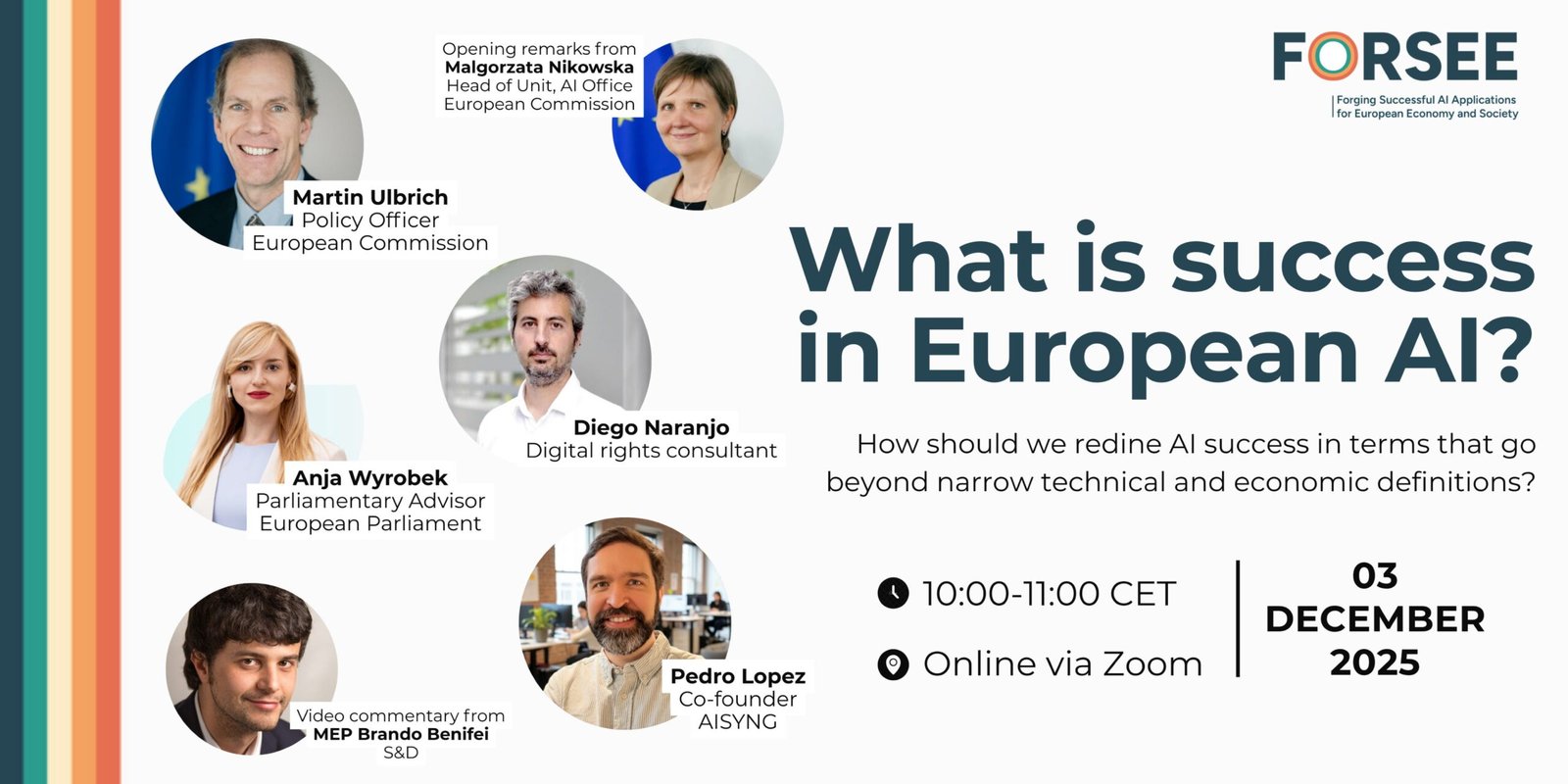
FORSEE webinar: Meet our panelists!

Only two weeks left until the webinar on European AI success! To build excitement, we’re introducing the exceptional lineup we’ve brought together for this timely discussion. As Europe moves toward greater AI sovereignty, defining what societal success means has never been more crucial. Our panelists, representing EU institutions, civil society, and the AI industry, bring … Read more

Webinar: What is success in European AI?

Join us for a FORSEE webinar exploring what it truly means for AI to succeed in Europe – beyond technical performance or economic growth. Europe is seeking greater AI sovereignty. Yet, a shared understanding of what constitutes AI’s societal success remains elusive. In the webinar, we will address the question: How can we ensure AI contributes to social … Read more

FORSEE survey for CSOs

Dear reader, We at FORSEE project are seeking to better understand how AI systems can affect people differently – especially women, LGBTQ+ individuals, and other gender-vulnerable groups. Our mission is to analyse existing successful AI applications to: University College Dublin, the leader of the FORSEE project, is inviting Civil Society Organisation (CSO) workers and members … Read more

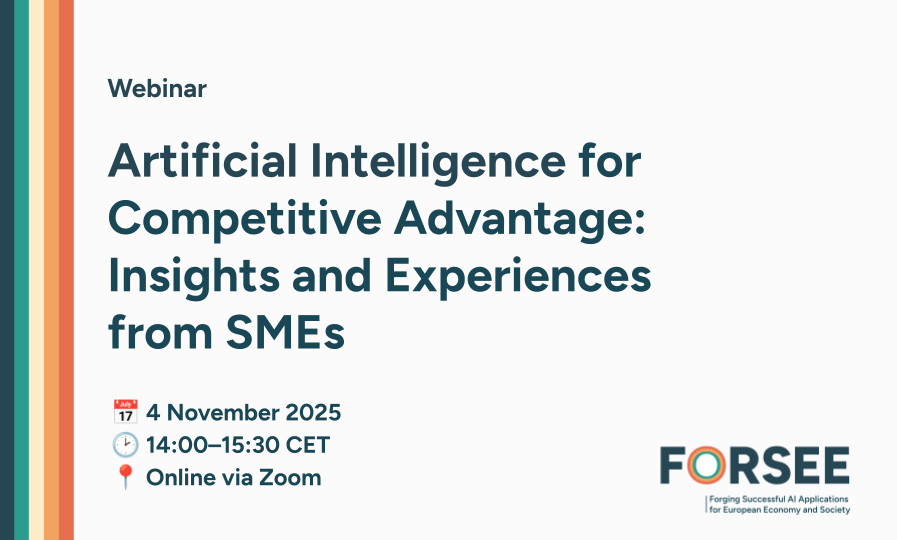
Webinar: AI for SMEs’ Competitive Advantage

We warmly welcome you to join our webinar “AI for Competitive Advantage: Insights and Experiences from SMEs”, taking place on 4 November 2025 at 14:00–15:30 CET via Zoom. This webinar explores how European small and medium-sized enterprises (SMEs) are adopting and applying AI to strengthen their competitiveness. Participants will hear directly from companies about their experiences, challenges, and … Read more

The FORSEEable: July 2025

News from the field of AI Competing visions for AI governance One of FORSEE’s objectives is strengthening Europe’s capacity to govern AI in line with its values, laws, and societal priorities. Hence, we are closely following the AI policies within Europe. Recently, we’ve seen growing pressure to weaken or delay the EU AI regulation, often driven by … Read more


Points of contact

Project lead
Dr Elizabeth Farries
Director of the UCD Centre for Digital Policy
elizabeth.farries@ucd.ie 

Lead of Communication and Impact
Johannes Mikkonen
Demos Helsinki 
johannes.mikkonen@demoshelsinki.fi

Project Manager
Evangelos Papadamakis
UCD Centre for Digital Policy
vangelis.papadamakis@ucd.ie

Follow us

LinkedIn Bluesky

Newsletter

FORSEE is Horizon Europe funded Research and Innovation Actions project consisting of eight partners: ADAPT Centre, The School of Computer Science and Statistics at Trinity College Dublin; European Digital SME Alliance; Demos Helsinki; TASC; Tilburg Institute for Law, Technology and Society; UCD Centre for Digital Policy; University of Toulouse and WZB – Wissenschaftszentrum Berlin für Sozialforschung