News from the field of AI
Competing visions for AI governance
One of FORSEE’s objectives is strengthening Europe’s capacity to govern AI in line with its values, laws, and societal priorities. Hence, we are closely following the AI policies within Europe.
Recently, we’ve seen growing pressure to weaken or delay the EU AI regulation, often driven by industry lobbying. Industry advocates have long pushed for a sector-specific regulatory model typical of the U.S. legislative tradition. This contrasts with the EU’s founding ambition to establish harmonized, cross-sector rules for AI.
In early June, the European Commission’s technology chief, Executive Vice President Henna Virkkunen, said that delays for certain aspects of the AI Act may be possible. The European Commission has also postponed the release of voluntary guidelines after an official from Virkkunen’s cabinet met with representatives from major US technology companies. Swedish Prime Minister Ulf Kristersson became the first EU government leader to publicly call for a pause in the AI Act, criticizing the rules as “confusing”.
Meanwhile, DIGITALEUROPE published a policy brief advocating for removing regulatory burdens to help Europe maintain technological competitiveness. While the European Commission pledged to reduce reporting obligations by 25 % for large companies and 35 % for SMEs, DIGITALEUROPE advocates for 50 % cuts.
However, according to Reuters’ Foo Yun Chee, the Commission has rejected calls from companies and some member states to delay implementation. According to Politico, Henna Virkkunen has stated that the AI Act, Digital Services Act, and Digital Markets Act are non-negotiable in trade talks with the United States, reinforcing the EU’s commitment to autonomous tech governance.
With these competing discourses and models for AI regulation and policies, it’s crucial to ask how the EU can lead in shaping human-centric and sustainable AI governance amid shifting political winds.
Relying on voluntary codes of ethics for AI has long been critiqued for lacking enforceability and being prone to conflicts of interest.
In a recent FORSEE blog post, Dr. Marta Lasek-Markey and Prof. John Hogan argue for a human rights-based approach to AI governance. This framework offers legal grounding to protect people and communities in the face of powerful technologies.
Read the blog post: Why Do We Need A Human Rights-Based Approach to AI Governance?
Or listen to the Brain for Business podcast episode where Marta discusses this topic with Professor Linda Hogan:https://open.spotify.com/embed/episode/0jvS3fUnTSNoZQYVjh9uc4
AI’s Environmental Impact Still Overlooked
It is now widely acknowledged that the development and deployment of artificial intelligence systems come with significant environmental costs. Large-scale AI models rely on energy-intensive infrastructures, particularly data centers that consume vast amounts of electricity, water, and raw materials. Generative AI could produce up to 5 million tons of e-waste by 2030.
However, AI is still treated in public and policy discussions as an almost immaterial technology. This framing sidelines the physical and planetary costs of digital expansion.
While the European Union has committed to sustainable AI in various strategic documents, this ambition has not yet translated into concrete regulation.
The AI Act briefly acknowledges the environmental impact of AI, but its risk classification primarily focuses on the technical capabilities of AI systems and the sectors in which they are deployed. There are no binding environmental standards governing the development or deployment of AI. Instead, the Act relies on voluntary measures and standardization processes, particularly concerning the energy consumption of high-risk AI systems. Overall, the energy and resource demands of AI remain largely unaddressed in current policy frameworks.
Read FORSEE’s submission to the EU’s Apply AI Strategy: Embedding the environment into AI policy.
Updates from FORSEE

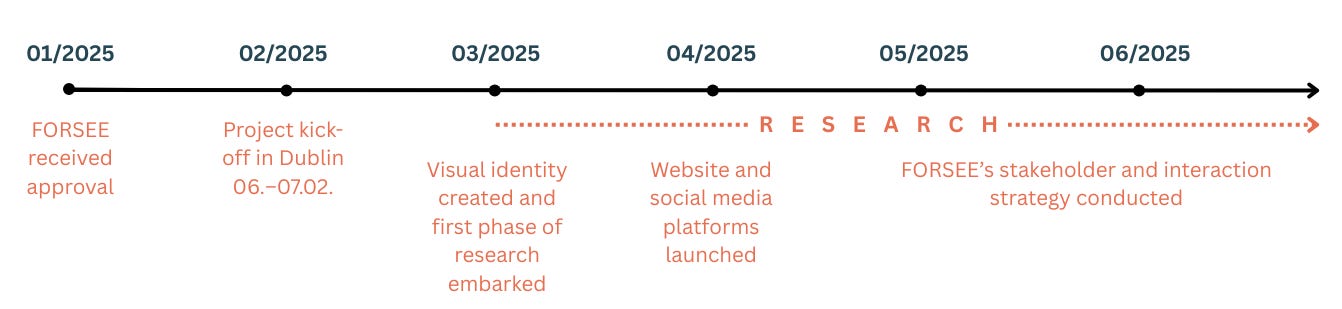
The first six months of FORSEE have been about kickstarting the project, establishing a visual identity and social media presence, and embarking on research activities. In February, the consortium gathered in Dublin to map out the project’s next steps. After the kickoff meeting, each team began to work on their assigned work packages.
Coordinated by the UCD Centre for Digital Policy, the FORSEE consortium consists of eight partners from diverse fields within the Social Sciences and Humanities. Get to know our team here!
In addition, FORSEE has an Ethics, Advisory, and Scientific Overview Board whose principal role is to act as a consultation and validation body for the project and to ensure that the project complies with all ethics requirements.
That’s the end of our first newsletter! Now we want to hear from you, the reader: What are your expectations for this series?
Are you more interested in hearing the latest news and discussions in the field of AI, or staying up to date with the work we do in the FORSEE project? Perhaps you would like to receive recommendations on related events, publications, content, etc. from projects or creators outside FORSEE? Or do you have something completely different in mind? Feel free to comment down below or get in touch with us on LinkedIn or Bluesky!