Welcome to the FORSEE Newsletter, your gateway to updates on research results and perspectives in societally successful AI.
Don’t be a stranger: check out our website, follow us on LinkedIn and Bluesky, and subscribe to this newsletter!
The path to AI success runs through regulation
Drawing on FORSEE’s research across multiple stakeholder groups, including policymakers, industry actors, civil society, media, and social media, this newsletter highlights how different visions of AI success shape the role of regulation.
In much of the European debate, regulation is framed as a constraint: something that may slow things down. The narrative is behind eight omnibus regulation packages of the EU, which aim to simplify EU legislation and reduce administrative costs and reporting requirements for EU businesses. Our analysis also documents the “over-regulation” narrative as a prominent discourse in the media.
But this framing misses something essential: AI success is conditional; regulation sets the conditions.
AI success is conditional: regulation is what sets the conditions.
While perspectives on AI success diverge significantly, one point of convergence is clear: there is support for hard-law regulation to guide AI development and address its societal impacts.
Ambitious regulation doesn’t only restrict; it signals direction and brings long-term clarity and predictability.
“I was very happy that the European Union was globally the first association of countries that started regulating this technology with a critical eye, but also enabled innovation.”
“If we reduce regulations, we’re essentially helping big tech and large enterprises consolidate.”
-Interviews from the Narrative framework on success among SME representatives
The EU AI Act represents the most substantial attempt yet to turn AI direction-setting into an enforceable structure. SMEs broadly welcome it as a framework for trust and accountability, while flagging real concerns about compliance burdens and the need for clearer, proportional guidance and sector-specific adaptation.
Similarly, CSOs express considerable scepticism as to whether existing AI regulation or its enforcement is adequate to the task:
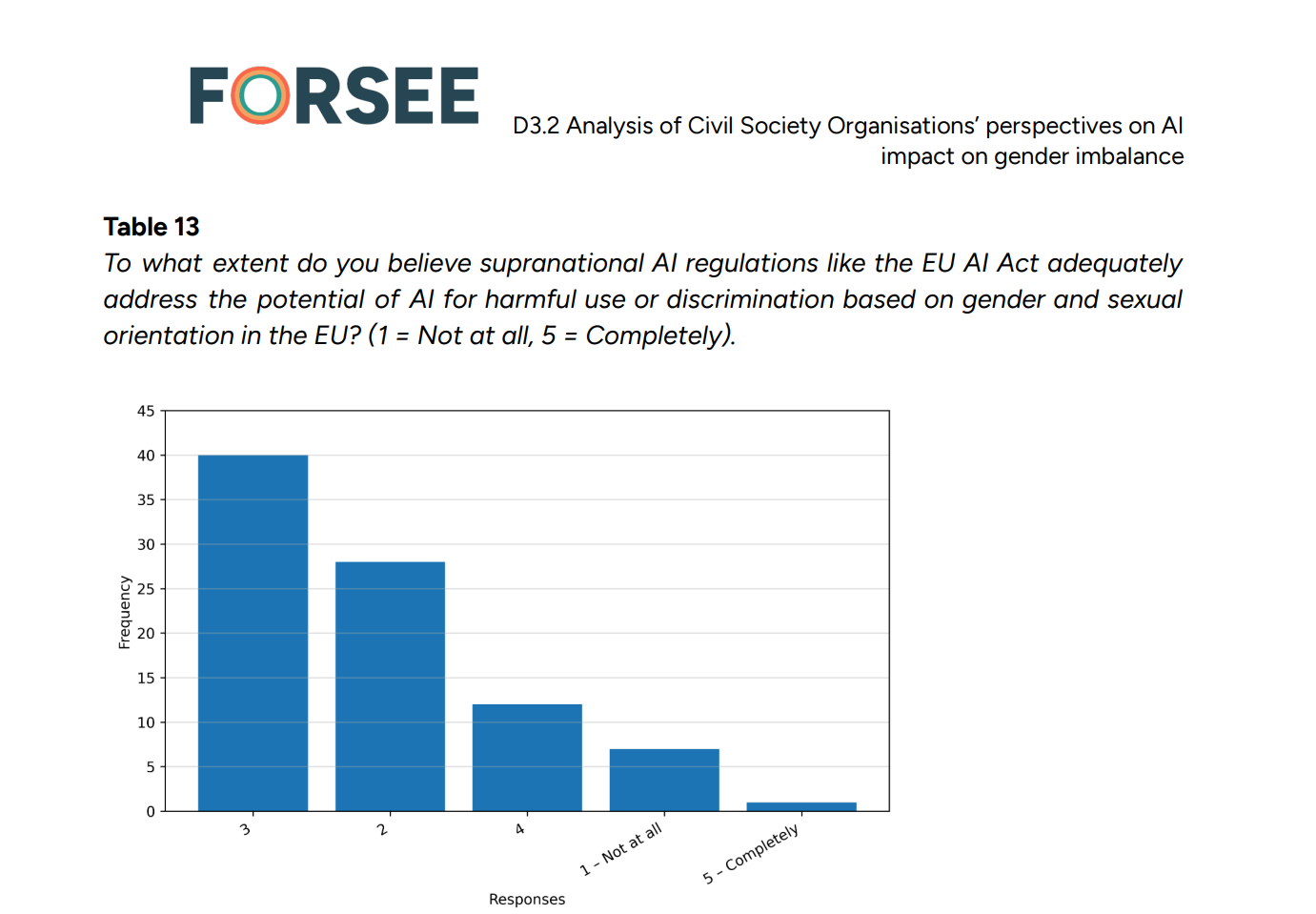
Figure from: Analysis of Civil Society Organisations’ perspectives on AI impact on gender imbalance
The missing dimension: risk, rights, and societal impact
Other stakeholders highlight dimensions of AI success that are far less visible in mainstream discourse.
Civil society organisations, in particular, emphasise risks related to:
- democratic erosion
- intensified surveillance
- gender and other forms of bias
- weak accountability of both public and private actors
“We’re seeing less human moderation, and more space for narratives that are extremely toxic and that previously were regulated.”
Similarly, public discourse on social media reflects growing concern about job displacement, deepfakes, and the erosion of human agency.
These perspectives reveal a broader understanding of AI success, one that extends beyond economic performance to include rights, trust, and long-term societal impact.
A growing gap between narratives and reality
FORSEE findings point to a structural gap: those shaping the narrative of AI success are not always those most affected by its consequences.
This is not just a communication issue. It has material implications for:
- How AI systems are developed
- What kinds of innovation are rewarded
- Whose risks are prioritised and whose are overlooked
For example, despite strong policy commitments to sustainability, environmental impacts remain largely absent from how AI success is evaluated in practice. Similarly, SMEs highlight growing dependency on dominant technology providers as a structural vulnerability.
From rules to reality: the challenge of implementation
The EU AI Act represents the most significant effort to date to translate political ambition into enforceable rules.
Yet a key challenge remains: implementation.
Evidence from legal practice suggests that while regulatory frameworks are expanding, their application is still uneven and evolving. Enforcement is developing slowly, and existing legal tools are only beginning to be applied to AI-related harms.
This creates an asymmetry:
- Concerns about “over-regulation” focus on the number of rules
- But in practice, the greater issue may be inconsistent and limited enforcement
For many stakeholders, especially SMEs, the challenge is not whether regulation exists, but whether it is:
- clear
- proportionate
- predictable
- and applicable in real-world contexts
The need for coherence
The challenge, then, may not primarily be too much regulation, but regulation that is incoherent in the conditions it’s trying to set, unpredictable, or unevenly applied.
Crucially, findings from FORSEE legal landscape research indicate a lack of case law addressing AI-related bias or discrimination. Despite societal concern regarding algorithmic fairness, these issues remain largely absent from the courtroom.
Indeed, across 20 landmark cases between 2022 and 2025, a clear pattern emerges: courts tend toward a laissez-faire posture in the upstream phases of AI development, data collection, and model training, thereby insulating early-stage innovation. But they apply a significantly stricter, rights-centred approach when AI systems directly impact individual decisions. The legislative muscle for applying existing regulations to AI is, in short, still at an early stage.
This creates an asymmetry. The discourse about over-regulation focuses on the volume of rules. But the empirical picture of AI litigation suggests a more specific problem: enforcement is inconsistent and accumulating slowly, while the technology moves fast.
Useful regulation, in this frame, has a key property that matters more than its volume: its coherence. This means alignment between what is rewarded and what is enforced. Coherence forms as a reflection of the big picture: the long-term objectives. These, in turn, necessitate shared conceptions of AI success.
Explore all FORSEE publications here.