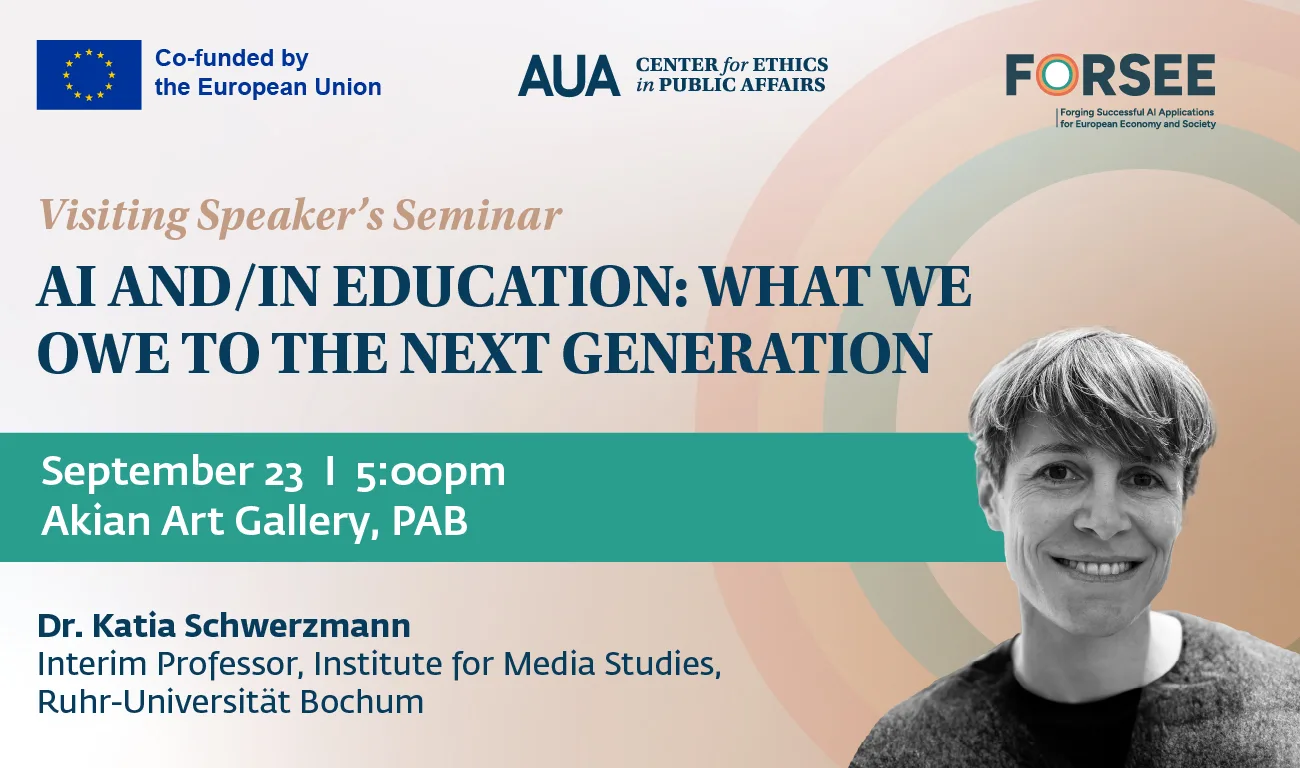
September 23, 5:00 pm – 7:00 pm, Akian Art Gallery
About the Event:
In this talk, Dr. Katia Schwerzmann, acting professor at Ruhr Universität Bochum, will present work from her current book project of the same title. Offering a media-philosophical critique of large language models as socio-technical systems, she examines their growing presence in educational contexts and their effects on pedagogy and the position of the student. Drawing on media studies, philosophy, critical theory, and with a keen technical grasp of how these systems actually work, she moves beyond narrowly framed ethical debates on AI’s “risks” and “opportunities,” grounding her analysis in how machine-learning- based algorithmic rationality shapes knowledge, subjectivity, and sociality, and what place this may, or may not, have in the university.
Please register here.
About the Speaker:
Dr. Katia Schwerzmann is a philosopher of media and technology and an acting professor at Ruhr Universität Bochum. Her current work focuses on how algorithmic rationality shapes knowledge, subjectivity, and sociality. She analyzes generative AI as a socio-technical system that produces new forms of power and subjectivity, regulating machine and human behavior through implicit and explicit norms, wherein Big Tech claims “interpretative sovereignty” over knowledge. She has published in AI & Society, Philosophy & Technology, Social Text, and other academic journals.


